Andrevuola
The DecameronAndrevuola’s story turns a secret love into a public test of grief, honor, and authority. In Brescia, she and Gabriotto become husband and wife without her family’s knowledge; his sudden death makes their private bond vulnerable to suspicion and coercion. She meets that danger with candor and resolve, but the story’s final movement is not a return to ordinary life: after her father honors Gabriotto in death, Andrevuola refuses another marriage and becomes a nun.
Identity and Background
Andrevuola is the young, unmarried, beautiful daughter of Messer Negro da Ponte Carraro, a gentleman in Brescia. Her parents love and protect her closely, in part because she is their only surviving child and they hope to make a distinguished alliance through her. The story sets that expectation beside her own choice of partner: Gabriotto, a neighbor of lower social standing, whose admirable conduct, handsome appearance, and pleasant manner win her love.
Their relationship begins through the assistance of a household maid. She helps Gabriotto learn that Andrevuola loves him and brings him into her father’s garden, where the two meet repeatedly. The lovers then become husband and wife in secret, determined that nothing short of death should separate them. Their private marriage gives their intimacy a commitment that Andrevuola later insists on preserving, even when the circumstances of Gabriotto’s death expose them to public scrutiny.
Love, Dreams, and Gabriotto’s Death
The night before Gabriotto dies, Andrevuola dreams that they are together in the garden, holding one another. A dark, frightening form emerges from his body, tears him from her embrace, and carries him underground; she wakes in anguish, relieved that the scene was only a dream but unsettled by its warning. When Gabriotto wants to visit the following night, she tries to dissuade him. Rather than risk making him suspect another reason for her reluctance, she receives him and eventually tells him what she saw.
The lovers meet in the garden amid white and red roses, beside a clear fountain. Gabriotto recounts a dream of his own, though its details are not given in the account here. As they embrace and kiss, Andrevuola repeatedly studies his face and scans the garden, fearing that the darkness from her dream may appear. The moment of intimacy is thus threaded with apprehension: her dream has not changed her love, but it has made her watchful.
Gabriotto suddenly sighs, asks for help, and falls onto the grass, saying that he is dying. Andrevuola draws him into her lap and asks what is wrong; he cannot answer. He pants and sweats, and soon dies. Physicians later determine that an abscess near his heart burst and suffocated him, rather than poison or violence. The dream’s image of a force tearing him away is fulfilled not by an attacker but by an unseen bodily catastrophe, a distinction that confirms the tragedy while leaving Andrevuola unable to prevent it.
Grief, Evidence, and Resistance
After finding Gabriotto cold and dead, Andrevuola summons the maid who knows of their love. She says she does not wish to continue living without him, but before taking any action she wants to protect their honor and secret and ensure his body is buried. The maid counsels her against suicide, arguing that it would imperil her soul, and proposes either burying him discreetly in the garden or leaving him where his family can find him. Andrevuola accepts the latter course.
She sends for a piece of silk kept in her coffer, spreads it on the ground, and lays Gabriotto upon it with his head on a pillow. She closes his eyes and mouth, makes a chaplet of roses, and covers him with the flowers they gathered together. Before they carry him toward his house, she removes the ring with which he had espoused her from her own finger and puts it on his. Her final gift gives visible form to the marriage the couple had kept hidden.
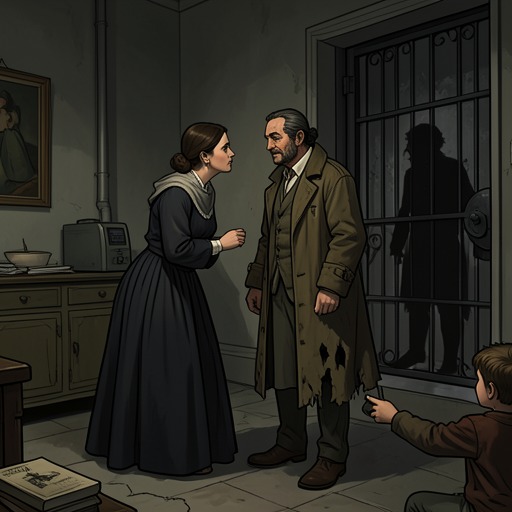
Officers of the provostry discover Andrevuola and the maid as they carry the body. Andrevuola does not attempt to flee: she agrees to explain what happened before the authorities, while warning the officers not to touch her or remove anything from the body. At the palace, the provost has physicians examine Gabriotto and learns that he was not poisoned or murdered. Yet instead of simply recognizing the facts and releasing her, he offers to free Andrevuola in exchange for sexual favors, then attempts to force her when she refuses. She resists him with indignation and scorn, refusing to let her grief or her vulnerable position become an excuse for his abuse of office.
Family Judgment and Final Choice
When Messer Negro hears what has happened, he goes to the palace with friends and demands his daughter’s release. The provost, fearing that she may accuse him of his attempted assault, acknowledges his conduct and praises her constancy. He then proposes to marry her, despite having already been told that she had a husband of humble standing. Andrevuola instead asks her father’s pardon for marrying without his knowledge, while asking to remain his daughter rather than become his enemy.
Messer Negro responds with grief and tenderness. He says he would have preferred a husband he judged suitable for her, but would also have accepted the man she chose; what pains him is that she concealed the marriage and that Gabriotto died before he could recognize him as a son-in-law. He makes that recognition after death: the body is laid out in the courtyard on Andrevuola’s silk cloth and covered with her roses, and Messer Negro orders a great and honorable funeral. The city joins the mourning, and Gabriotto is carried to his tomb on the shoulders of its noblest citizens, not treated as a commoner but honored as a nobleman.
Some days later, when the provost renews his marriage proposal, Messer Negro puts it to Andrevuola. She refuses. Her father accepts that decision, and Andrevuola and the maid enter a convent renowned for its sanctity, where they live honorably for many years. The ending grants Andrevuola a life beyond the immediate crisis, but not a new romantic union: she leaves the provost’s pursuit behind and chooses religious life after the public recognition and burial of the husband she had already chosen.
Narrative Significance
Andrevuola’s story repeatedly places private commitments before public judgment. Her marriage to Gabriotto is concealed from her family, but the ring, her care for his body, and her account before the provost make that bond legible even when she is exposed to legal and sexual pressure. The father who had hoped to arrange a distinguished match ultimately acknowledges the worth of the man his daughter chose, and the funeral gives public honor to a relationship that began in secrecy.
The paired dreams frame the lovers’ last meeting with foreknowledge, but the narrative does not let the dream replace physical evidence: physicians identify the immediate cause of death, and the officers’ investigation establishes that no one killed Gabriotto. Andrevuola’s response to the dream’s fulfillment is likewise practical as well as emotional. She protects the dead man’s dignity, stands her ground before the provost, and speaks openly to her father. Her final refusal and entry into the convent give the tale a quiet, consequential ending: the family’s reconciliation and Gabriotto’s public honor do not erase her loss or dictate another marriage.